
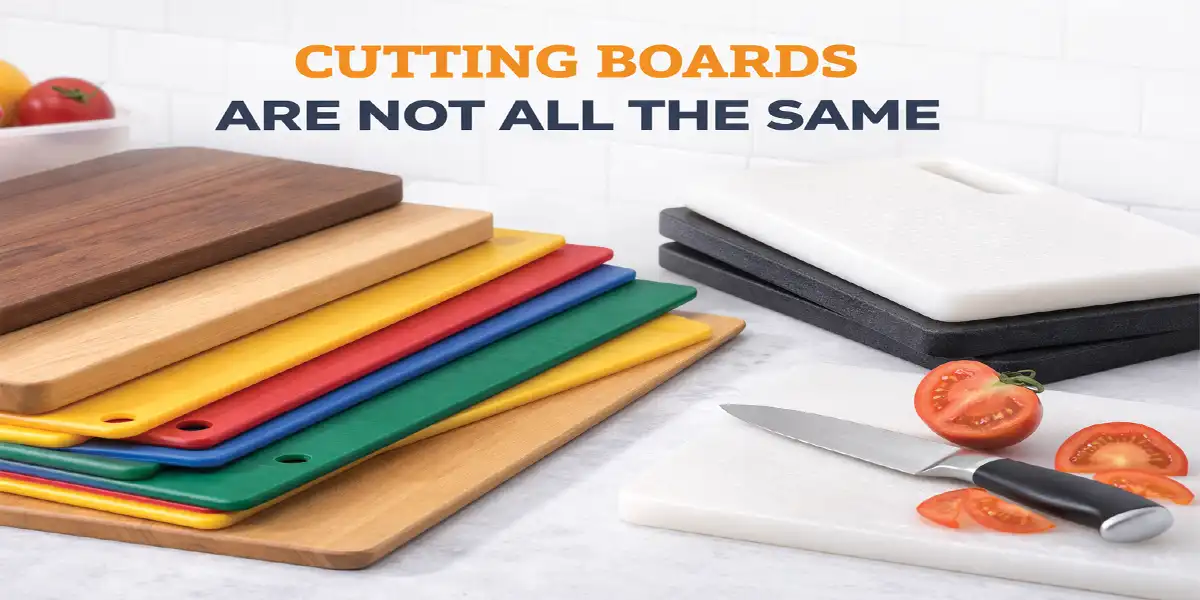
Why Certified Food-Grade Quality Matters More Than Price
In professional kitchens, cutting boards are a critical food-contact component, not an accessory. Yet many operators unknowingly use non-certified boards that expose them to contamination risks, failed inspections, and legal liability.
The difference between certified food-grade cutting boards manufactured under European regulations and non-certified imported alternatives is substantial—both technically and legally.
This article explains those differences clearly.
The Core Risk with Non-Certified Cutting Boards
Many low-cost cutting boards enter the market labeled as “food grade” without verifiable proof. The issue is not origin alone—it is lack of documented compliance.
1. No Declaration of Conformity = No Protection
Uncertified cutting boards typically lack:
-
EU Declaration of Conformity (DoC)
-
Global migration test results
-
Traceable batch control
-
Defined limits for chemical migration
In an inspection or incident, the responsibility falls on the kitchen operator, not the reseller.
European food-contact law is explicit:
-
Materials must not transfer substances to food in quantities that could endanger health
-
Compliance must be demonstrable, not assumed
Reference:
-
EU Regulation (EC) No. 1935/2004
https://eur-lex.europa.eu/legal-content/EN/TXT/?uri=CELEX:32004R1935
2. Inferior Plastic Structure Accelerates Contamination
Many non-certified boards are produced using:
-
Recycled polymers
-
Low-density plastics
-
Uncontrolled additives
These materials:
-
Develop deep knife grooves quickly
-
Trap moisture and food residue
-
Absorb odors
-
Become unhygienic long before they look damaged
Once bacteria penetrate the surface, cleaning becomes superficial.
What Defines a Certified German-Origin Food-Grade Cutting Board
1. High-Density Polyethylene Engineered for Food Contact
Our cutting boards are manufactured from high-density polyethylene (PE-HMW / PE 500) designed specifically for food and industrial use.
Key material properties include:
-
Density approx. 0.96 g/cm³
-
Extremely low water absorption (~0.01%)
-
High resistance to abrasion and knife wear
-
Non-porous, odor-neutral surface
-
Excellent mechanical strength and impact resistance
These characteristics are documented in the material’s technical data sheet
STAR PE 500 ENG
This is not generic plastic—it is engineered polymer.
2. Full Compliance with EU Food-Contact Regulations
The material used complies with:
-
EU Regulation (EC) No. 1935/2004
-
EU Regulation (EU) No. 10/2011 (plastic materials intended to contact food)
Global migration tests confirm that the material does not exceed permitted migration limits, even when containing authorized additives or pigments
STAR Unbedenklichkeitsbescheini…
.
This means:
-
No harmful substance transfer
-
No regulatory ambiguity
-
Full audit readiness
3. Controlled Use of Approved Additives Only
Where color coding is required, only authorized pigments and dual-use additives are used—substances already permitted as food additives under EU law.
This ensures:
-
Color stability over time
-
No pigment bleeding
-
No impact on food taste or safety
Documented in the conformity declaration
STAR Unbedenklichkeitsbescheini…
Professional Color Coding for HACCP Control
Certified cutting boards follow internationally accepted hygiene logic:
-
Blue – raw fish
-
Green – vegetables
-
White – dairy and bakery
This system reduces cross-contamination risk and supports HACCP implementation.
Reference:
-
Codex Alimentarius – General Principles of Food Hygiene
https://www.fao.org/fao-who-codexalimentarius/en/
The Cost Illusion Most Buyers Fall Into
Cheap boards appear economical only at purchase.
In reality:
-
They wear faster
-
Require frequent replacement
-
Increase contamination risk
-
Create inspection exposure
Certified boards last longer, clean better, and protect the business, not just the cutting surface.
Professional kitchens do not optimize for the cheapest item—they optimize for control and compliance.
Final Perspective
If a cutting board touches food, documentation matters more than appearance.
A certified, German-origin food-grade cutting board is not a luxury.
It is a compliance tool, a hygiene barrier, and a risk-reduction asset.
If a product cannot prove conformity, it should not touch food.
Availability, Shipping, and Regional Experience (Riyadh & Doha)
Compliance does not stop at manufacturing. It must extend to logistics, documentation, and regional acceptance.
Alpha supplies certified food-grade cutting boards to professional kitchens across the GCC, including Riyadh and Doha. We routinely ship to both cities and already serve customers operating under local municipality inspections and food safety requirements.
This matters for two reasons:
-
Regulatory Expectations Are Rising
Saudi Arabia and Qatar increasingly align with international food-contact standards. Inspectors expect traceability, material documentation, and conformity—not generic “food grade” claims. -
Documentation Travels with the Product
Our cutting boards are supplied with clear technical and compliance documentation, ensuring smooth acceptance during delivery, inspection, and operational audits—whether the kitchen is in the UAE, Riyadh, or Doha.
Alpha does not treat cross-border supply as an exception.
It is part of our standard operating model.